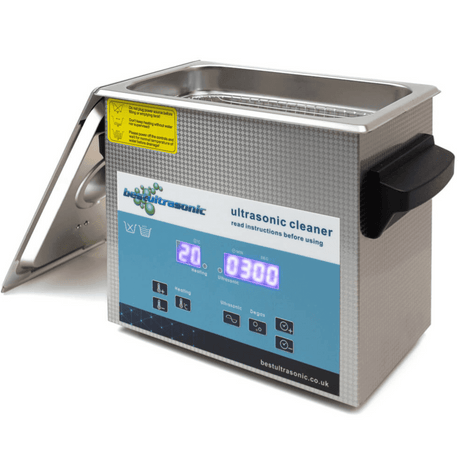
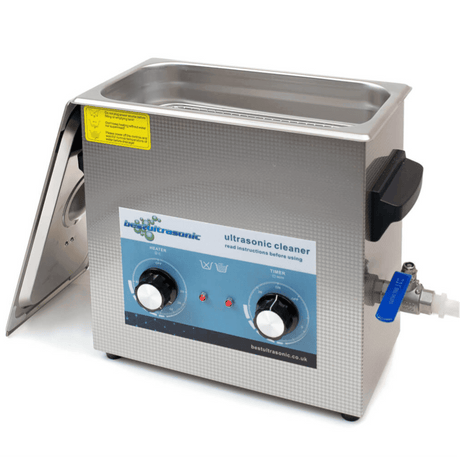
Looking for an ultrasonic jewellery cleaner for your home, workshop or jewellery business? Our stainless-steel cleaners use ultrasonic sound waves to remove dirt, grease and polishing residue from suitable jewellery—even from small gaps that are difficult to reach with a brush.
Choose from 2, 3, 6 and 10 litre tanks with simple dial controls, digital controls with degassing, or adjustable ultrasonic power. Every machine includes a cleaning basket, UK mains plug, two-year warranty and UK-based technical support.
What is an ultrasonic jewellery cleaner?
An ultrasonic jewellery cleaner is a tank that uses high-frequency sound waves to clean suitable jewellery in a mixture of water and cleaning fluid.
The sound waves create millions of microscopic bubbles in the liquid. These bubbles rapidly form and collapse in a process known as cavitation. This gently loosens dirt and contamination from jewellery surfaces, settings, links, chains and other awkward areas. The result is a thorough clean without all the scrubbing—and who doesn’t like that?
Which ultrasonic jewellery cleaner should I buy?
The best model depends on three things:
- The size of the jewellery you need to clean
- How often you will use the cleaner
- How much control you want over the cleaning process
For occasional or home use, a compact 2 litre cleaner may be all you need. Professional jewellers and busy workshops may prefer a 3, 6 or 10 litre model with more basket space.
The most important measurement is not simply the tank capacity. Check the internal basket dimensions to make sure your jewellery will fit comfortably. The basket is slightly smaller than the tank, so always use the basket measurements shown on each product page.
Which tank size do I need?
2-litre ultrasonic jewellery cleaners
A 2 litre model is a compact choice for rings, earrings, chains and other small items. It is suitable for home users, hobby jewellery makers and professionals who usually clean smaller pieces.
3-litre ultrasonic jewellery cleaners
The 3 litre size offers more working space without taking up too much room on a bench or counter. It is a popular choice for jewellers, watchmakers and repair workshops.
6-litre ultrasonic jewellery cleaners
A 6 litre cleaner has a longer and deeper basket, making it useful for larger pieces or cleaning several suitable items together. Many professional users find this a practical size for everyday workshop cleaning.
10-litre ultrasonic jewellery cleaners
Choose a 10 litre model if you regularly clean larger items, multiple pieces or batches of jewellery. Always check the basket dimensions before ordering, as the shape of the item matters just as much as its overall size.
Should I choose dial, digital or adjustable-power controls?
We offer three types of control, so you can choose the one that suits the way you work.
Dial-control ultrasonic cleaners
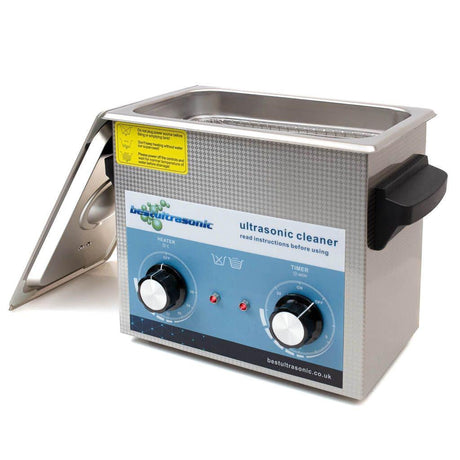
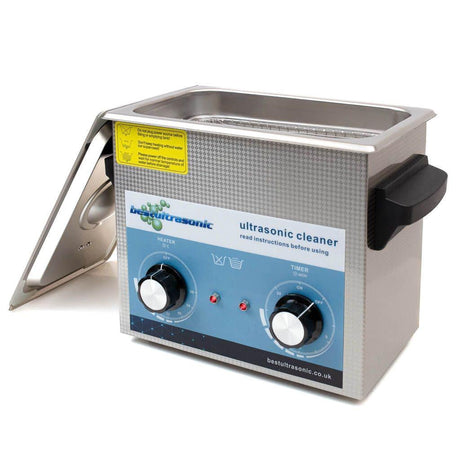
Dial models provide a simple and reliable way to adjust the timer and heater. The controls are easy to use and can be operated while wearing protective gloves.
These models are a good choice if you want straightforward controls without an electronic display.
Digital ultrasonic cleaners with degassing
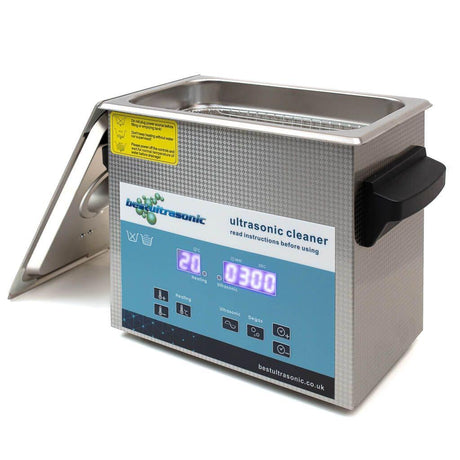
Digital models let you set the cleaning time and temperature using push-button controls. The display shows the selected settings and makes it easier to monitor the cleaning process.
They also include a degassing function. Degassing removes trapped air from freshly mixed cleaning solution, helping the ultrasonic energy travel through the liquid more effectively.
Adjustable-power ultrasonic cleaners
Adjustable-power models allow you to reduce or increase the ultrasonic output. This gives you greater control when cleaning different items and is particularly useful when a less aggressive cleaning action is required.
Reducing the power does not automatically make every delicate item safe to clean, so always check the jewellery manufacturer’s care instructions first.
Can ultrasonic cleaners make jewellery sparkle again?
An ultrasonic cleaner can remove the dirt, grease, soap and general residue that often makes jewellery look dull. Cleaning around links, settings and recessed areas can help restore the item’s natural shine.
However, an ultrasonic cleaner does not repair scratches, worn plating, damaged settings or permanently tarnished surfaces. The final result will depend on the material and condition of the jewellery.
What jewellery can be cleaned ultrasonically?
Many solid-metal items and some securely set, durable gemstones can be cleaned ultrasonically. However, not every piece of jewellery is suitable.
Avoid ultrasonic cleaning unless the manufacturer or a qualified jeweller confirms it is safe for:
- Costume jewellery
- Pandora jewellery
- Plated or foil-backed jewellery
- Jewellery containing glued stones
- Loose or damaged settings
- Pearls, opals, emeralds and other porous or delicate stones
- Treated, cracked or heat-sensitive gemstones
- Antique or fragile jewellery
Always inspect the item before cleaning. If a stone is already loose, ultrasonic vibration could make the problem worse.
When in doubt, ask a professional jeweller before placing the item in the tank.
Do I need jewellery cleaning fluid?
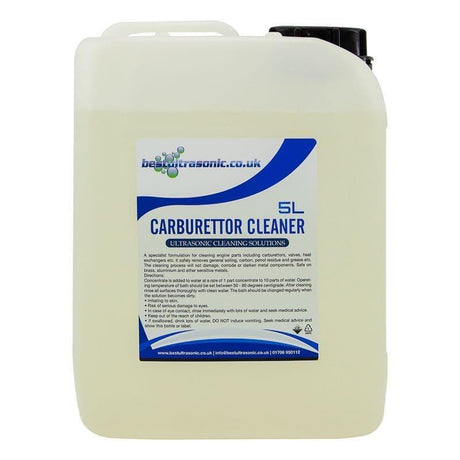
Yes. For the best results, use a suitable ultrasonic jewellery cleaning fluid.
Water carries the ultrasonic waves, while the cleaning solution helps break down grease, fingerprints and other contamination. Always follow the fluid manufacturer’s dilution, temperature and safety instructions.
How do I use an ultrasonic jewellery cleaner?
The exact method will depend on the item and cleaning fluid, but the basic process is simple:
- Fill the tank to the recommended level with clean water.
- Add the correct amount of ultrasonic jewellery cleaning fluid.
- Degas freshly mixed solution if your machine has a degassing function.
- Place the jewellery in the supplied basket.
- Select a suitable cleaning time and temperature.
- Start with a short cycle and inspect the item.
- Rinse and dry the jewellery as directed by the cleaning-fluid instructions.
Do not place jewellery directly on the bottom of the tank. Always use the supplied basket and follow the user manual for your machine.
Why buy from Best Ultrasonic Cleaners?
We specialise in ultrasonic cleaning equipment and fluids for both professional and home use. Our jewellery-cleaning range includes:
- Stainless-steel tanks and bodies
- UK 13 amp plugs and mains leads
- Baskets for standard and smaller items
- Heated cleaning on every model
- 40 kHz ultrasonic cleaning
- Two-year warranty
- UK-based technical telephone support
- A choice of tank sizes and control systems
If you are unsure which model will suit your jewellery, measure the largest item you need to clean and compare it with the basket dimensions on each product page.
Frequently asked questions
What size ultrasonic cleaner is best for jewellery?
A 2 or 3 litre cleaner is suitable for many home users, jewellers and small workshops. A 6 or 10 litre tank provides more basket space for larger items or batch cleaning. Always choose by the internal basket dimensions rather than tank capacity alone.
Is an ultrasonic jewellery cleaner suitable for professional use?
Yes. Our stainless-steel ultrasonic jewellery cleaners are designed for jewellers, watchmakers, repair workshops and other professional users. Models are available with dial controls, digital degassing and adjustable power.
Can I clean several pieces of jewellery together?
Yes, provided the items are suitable for ultrasonic cleaning and fit comfortably inside the basket. Avoid overcrowding the basket or allowing pieces to rub against each other during cleaning.
How long does ultrasonic jewellery cleaning take?
Many items can be cleaned using a short cycle of a few minutes, although the correct time depends on the material, condition and level of contamination. Start with a short cycle, inspect the jewellery and repeat if necessary.
Does an ultrasonic cleaner remove tarnish?
It can remove dirt and residue covering a tarnished surface, but it may not remove chemical tarnishing from the metal itself. A suitable polishing or specialist cleaning process may still be required.
Can I clean watches in an ultrasonic cleaner?
Complete watches should not be submerged unless the manufacturer specifically confirms that ultrasonic cleaning is safe. Watch bracelets and dismantled components may be suitable, but they should be checked by a watchmaker first.
Can I use washing-up liquid in the tank?
A purpose-made ultrasonic jewellery cleaning fluid will normally give better and more predictable results. Always use a solution that is compatible with both your machine and the item being cleaned.
Are ultrasonic cleaners safe for diamonds?
Some securely mounted, untreated diamonds may be suitable, but the setting and condition of the jewellery must also be considered. Do not clean a ring ultrasonically if the stone is loose, the setting is damaged or the manufacturer advises against it.